It's kind of conventional; it's pantheism. One common misconception (maybe due to his borrowing of Ionian symbolism) is that Heraclitus' logos was personal, or had any sort of personal quality to it. Not so. Though he asserts human law should be some sort of embodiment of this perfect logos, our attempts will be relative, finitely conceived, and, thus, imperfect.
***
If I think about Zeus enough...I easily call myself an atheist. I wonder what's changed. Daniel C. Dennett suggests much has changed-- that our God now is less of a man (with lightning bolts or what have you) than a formless form, a law of harmony, a "higher being," etc. since obviously we can't sensibly accept certain ideas about God. Yet a few attributes remain, one being 'existence,' another 'good.' Heraclitus' thunder-god and Plato's oozes have a dualistic reality in common-- that of appearances and that of objective reality, or direction.
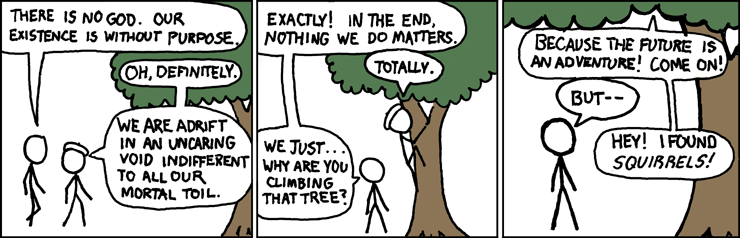
The universe, even if muddied by human imprecision, is not "aimless". It is not a void. It is not "nothing," thank GOD!
AMC