


- Joined
- Dec 29, 2007
- Messages
- 5,114
- Reaction score
- 1,322
Atheists have many different viewpoints, but one viewpoint that seems almost universal is a concern about the truth and a visceral abhorrence for religious deceit. Certainly, when atheists have gone up against religious deceit they’ve often done so passionately, and sometimes at significant personal cost.
But that’s interesting from a moral and ethical perspective: what obligations do atheists feel they have to the truth?
What follows is personal perspective on this question: the question of lies, liars and atheism.
Let me start with a blunt observation: religions are often caught in lies, and many atheists find religious lying deeply offensive. I've included a few examples so you'll know what I mean.
Religions often lie in their claims to have insider knowledge on absolute truths - both physical and metaphysical. Yet history shows that the physical truths often move away from their doctrine, and that religions will frequently rework their metaphysical truths to reach a larger audience.
They often lie in how much they claim that their deities will care for us. History shows us that a kid with two stable, loving parents, a solid education and modern medicine but no religion does far better on average than an orphan with religion but no education and no medicine. So inasmuch as deities are meant to be a 'hidden hand' helping people, they're clearly not helping as much as good social services.
Religions often lie when they say that you can apprehend truth through faith alone. They often get caught out when history shows that they've been changing their own stories to fit newly discovered facts.
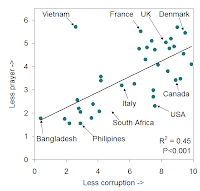
Religions often like to scare-monger and say that a materialistic world is predisposed toward decadence and moral decay; that religious guidance is necessary for humans to behave civilly. Yet history shows us that as social services improve, we become better behaved to one another. On the other hand, when social services are poor, people behave worse to one another - regardless of how strong the local religion is.
These examples are for illustration and lest this be seen as religion-bashing, I should acknowledge something important: many critical social services are supplied by religious institutions, and have been for hundreds - even thousands - of years. Indeed, many modern social services (like hospitals, emergency food, shelter, orphanages) were invented by religious institutions. That's not at issue for this discussion - what's at issue are the deceitful (or heavily misguided) claims that accompany the often good works.
It seems to me that religions lie for the same reason that politicians do - because they need power to sustain their institutions and vested interests. When they lie, they do so glibly, egregiously, publicly and shamelessly and it offends many atheists. The porkies they tell can be breathtaking in their magnitude and brazenness (if you want to lie well, lie big).
That's all reprehensible and regrettable, and atheists may well tut and sneer, but here's the thing:
I'm not persuaded that atheists lie any less.
Are atheists more prompt to admit wrongs? To acknowledge mistakes? Are they less likely to be convicted for criminality? I haven’t seen any stats on this, but my gut says probably not. Individual examples aren’t always indicative, but the most scrupulously honest people I know are almost all theists. Whatever’s happening at the institutional level, at the personal level I’d rate honesty among devout theists to be higher than that among the staunch atheists.
At a national level there aren't many countries where atheism is legislated - the only ones I can think of are the former USSR, communist China and North Korea. These are not countries renowned for their scrupulous honesty – though that may have more to do with political regime than anything to do with their faith.
But this leads me to wonder: why are atheists so sanctimonious about religious lies, yet so sanguine about their own? Why are they so vocal about big sectarian lies, but not big secular lies?
Most of the time I think that religious lies are largely immaterial – even vaguely benevolent. Saying that ‘prayer will save your husband’s life’ at least may give the family comfort and probably won’t hurt the husband. (The last stats I saw suggested that prayer is linked to a slightly reduced recovery rate from illness – whether that’s because all the praying worries the patient, or the more serious patients get more prayers I don’t know). On the other hand, many secular lies – the big, cultural lies we tell ourselves – often do a lot of harm. So why aren’t atheists as passionate about these lies?
All cultures lie to themselves - that's what myths are. These lies can do some social good. They can make us kinder, more tolerant, more civil, braver, more generous, more honest and more decent to one another. Our hero myths are lies of this sort. Many religious myths are of this sort too.
But our cultural lies can also divide, harm and thieve social good from one group to benefit another. The lies underpinning racism, sexism and nationalism are of this sort.
So if atheists dislike religious lying, is it hypocritical for them to tolerate these other forms of lying? What are a 'good' atheist's obligations toward the truth?
[In closing, I should say that I find it a bit ironic to post this question as a fiction-writer. After all, it’s an avocation that capitalises on and exploits lies. Even more than that, as writers we have a strong personal stake in our lies getting more airplay than other folks' lies (that’s what successful publication means, right?) And gee, that sounds similar to the way some religions work, doesn’t it? ]
]
But that’s interesting from a moral and ethical perspective: what obligations do atheists feel they have to the truth?
What follows is personal perspective on this question: the question of lies, liars and atheism.
Let me start with a blunt observation: religions are often caught in lies, and many atheists find religious lying deeply offensive. I've included a few examples so you'll know what I mean.
Religions often lie in their claims to have insider knowledge on absolute truths - both physical and metaphysical. Yet history shows that the physical truths often move away from their doctrine, and that religions will frequently rework their metaphysical truths to reach a larger audience.
They often lie in how much they claim that their deities will care for us. History shows us that a kid with two stable, loving parents, a solid education and modern medicine but no religion does far better on average than an orphan with religion but no education and no medicine. So inasmuch as deities are meant to be a 'hidden hand' helping people, they're clearly not helping as much as good social services.
Religions often lie when they say that you can apprehend truth through faith alone. They often get caught out when history shows that they've been changing their own stories to fit newly discovered facts.
Religions often like to scare-monger and say that a materialistic world is predisposed toward decadence and moral decay; that religious guidance is necessary for humans to behave civilly. Yet history shows us that as social services improve, we become better behaved to one another. On the other hand, when social services are poor, people behave worse to one another - regardless of how strong the local religion is.
These examples are for illustration and lest this be seen as religion-bashing, I should acknowledge something important: many critical social services are supplied by religious institutions, and have been for hundreds - even thousands - of years. Indeed, many modern social services (like hospitals, emergency food, shelter, orphanages) were invented by religious institutions. That's not at issue for this discussion - what's at issue are the deceitful (or heavily misguided) claims that accompany the often good works.
It seems to me that religions lie for the same reason that politicians do - because they need power to sustain their institutions and vested interests. When they lie, they do so glibly, egregiously, publicly and shamelessly and it offends many atheists. The porkies they tell can be breathtaking in their magnitude and brazenness (if you want to lie well, lie big).
That's all reprehensible and regrettable, and atheists may well tut and sneer, but here's the thing:
I'm not persuaded that atheists lie any less.
Are atheists more prompt to admit wrongs? To acknowledge mistakes? Are they less likely to be convicted for criminality? I haven’t seen any stats on this, but my gut says probably not. Individual examples aren’t always indicative, but the most scrupulously honest people I know are almost all theists. Whatever’s happening at the institutional level, at the personal level I’d rate honesty among devout theists to be higher than that among the staunch atheists.
At a national level there aren't many countries where atheism is legislated - the only ones I can think of are the former USSR, communist China and North Korea. These are not countries renowned for their scrupulous honesty – though that may have more to do with political regime than anything to do with their faith.
But this leads me to wonder: why are atheists so sanctimonious about religious lies, yet so sanguine about their own? Why are they so vocal about big sectarian lies, but not big secular lies?
Most of the time I think that religious lies are largely immaterial – even vaguely benevolent. Saying that ‘prayer will save your husband’s life’ at least may give the family comfort and probably won’t hurt the husband. (The last stats I saw suggested that prayer is linked to a slightly reduced recovery rate from illness – whether that’s because all the praying worries the patient, or the more serious patients get more prayers I don’t know). On the other hand, many secular lies – the big, cultural lies we tell ourselves – often do a lot of harm. So why aren’t atheists as passionate about these lies?
All cultures lie to themselves - that's what myths are. These lies can do some social good. They can make us kinder, more tolerant, more civil, braver, more generous, more honest and more decent to one another. Our hero myths are lies of this sort. Many religious myths are of this sort too.
But our cultural lies can also divide, harm and thieve social good from one group to benefit another. The lies underpinning racism, sexism and nationalism are of this sort.
So if atheists dislike religious lying, is it hypocritical for them to tolerate these other forms of lying? What are a 'good' atheist's obligations toward the truth?
[In closing, I should say that I find it a bit ironic to post this question as a fiction-writer. After all, it’s an avocation that capitalises on and exploits lies. Even more than that, as writers we have a strong personal stake in our lies getting more airplay than other folks' lies (that’s what successful publication means, right?) And gee, that sounds similar to the way some religions work, doesn’t it?
]


 (Hmm, actually give me the Panopticon instead.

