Castles and Kings

phantasy

I write weird stories.
Super Member
Registered
Joined
Dec 16, 2012
Messages
1,895
Reaction score
259
Location
The Moon
Hi all, I just had some questions maybe those of you more familiar with historical fiction or fantasy. If you can also give me links or point to resources, that would be great. Examples from stories/books work too.

How did castles work? Their basic structure? Did they all have gates, moats or just doors?

Did someone just walk in or do you need an appointment? Was the door open or was it always guarded? How many guards? What did kings do all day, where did they sit? How did one go about to meet the king?
It doesn't just have to be european kings, other types of royalty would be good to learn about too.

Did kings have secretaries and councils? What was the protocol for that?

Thanks!
 

Drachen Jager

Professor of applied misanthropy
Super Member
Registered
Joined
Mar 13, 2010
Messages
17,169
Reaction score
2,283
Location
Vancouver
Every castle is different. Some had moats, some had doors (although most had gates). Far more common than moats were mountains. Most of the real war-castles I've seen are on mountains. "Castles" that are more like palaces with some nods to defensive architecture tend to be those with moats, though I suppose it depends on whether you have a mountain available as well.

Typical castle entrance, doors or a gate and a portcullis (metal bars, like a prison cage that lowers from the ceiling. Beyond that is a large chamber with arrow slits and such in the roof, possibly holes for pouring boiling oil or other nasty things as well. Beyond that, another gate/portcullis/door. If you make it out of that building, guess what? There's probably a hundred yards or so of open terrain you have to cross, while the defenders on the walls on both sides rain down arrows on you, if you make it through that, repeat step 1.

The most of those I've seen is seven on a steep hill. Pretty much untakable.

There are plenty of maps, if you do a google image search for, medieval castle map. Most of them are a little simpler than the design I was talking about.

Vianden is one of my favorites, worth googling for some images. Beautiful town too.

Most of the rest depends a lot on the era, war footing etc.

Normally a King would be guarded. Not many people could see him without an appointment, but a Duke or other high noble could. Ordinary people couldn't "meet" the King in most settings. You had to have some status.

Most Kings had a council of sorts, protocol varied depending on the King.
 

Drachen Jager

Professor of applied misanthropy
Super Member
Registered
Joined
Mar 13, 2010
Messages
17,169
Reaction score
2,283
Location
Vancouver
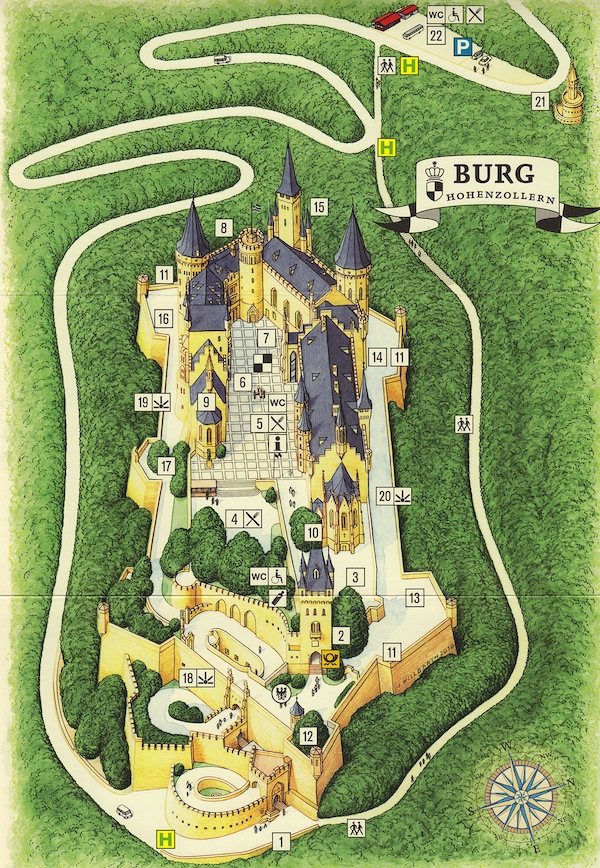
This is another castle I've visited. Google image Hohenzollern for some pictures. I'm in pretty good shape and it took me twenty minutes of grinding to get from the parking lot up a 30 degree slope to get to 1 on this map (if you go straight up the side of the hill it's more like 50 to 60 degrees most of the way). From 1 note you go through a gate, then through a full 360 degrees enclosed where they can shoot you at will. Make it out from that and you have to do another 360 degrees in the open before you make it to gate 2.


Hohenzollern+Castle+Brochure+Folded+Map.jpg
 

phantasy

I write weird stories.
Super Member
Registered
Joined
Dec 16, 2012
Messages
1,895
Reaction score
259
Location
The Moon
Thank you so much for that! It's a big help. Any books I should read?
 

waylander

Who's going for a beer?
Super Member
Registered
Joined
Oct 24, 2005
Messages
9,768
Reaction score
2,418
Age
67
Location
London, UK
Did kings have secretaries and councils? What was the protocol for that?

Thanks!

It depends on how hands-on the king wished to be.
Example Louis XIV of France - L'etat, c'est moi!' ran everything.
Example the other way - Richard I of England spent very little time in the country as he was away being 'The Lionheart', crusading and other warrior stuff.

He's your king - decide how you want him to run things.
 

King Neptune

Banned
Joined
Oct 24, 2012
Messages
4,253
Reaction score
372
Location
The Oceans
It doesn't just have to be european kings, other types of royalty would be good to learn about too.

Did kings have secretaries and councils? What was the protocol for that?

Thanks!

How kings operated varied widely from place to polace and time to era. In a non-literate society there would hve been no secretary, obviously, but there were people whse business it was to keep track of things. In small kingdoms and very early kingdoms, there was little differentiation between kings and the rest of the world. SOme kings were elected for a relarively short period of time, and in some places and times the kings was just a war leader who had nothing to do when there was peace.

If you want to learn about kingship in general, then you will have to read widely in history. There have been some general works on svereignty, but those were about the power held, rather than concentrating on the day-to-day operations.
 

benbenberi

practical experience, FTW
Super Member
Registered
Joined
Jul 7, 2012
Messages
3,654
Reaction score
3,032
Location
Connecticut
1) A castle is a structure with a primarily military function. Many castles were built and occupied by people who were not kings. Conversely, many kings have lived and worked in buildings that are not castles. There's no necessary connection between castle and king.

2) Both castles and kings/royal governments were continuously evolving in response to local conditions, so answers that may be correct for one time and place are wildly wrong for another. (For instance, absolutely nothing that is true for kings and castles in 8th century England will be true for kings and castles in 16th century Spain.) To get good answers to your questions, and build a story world that is internally consistent, you really need to narrow your focus more specifically.

How did castles work? Their basic structure? Did they all have gates, moats or just doors?

The main military function of a castle was to provide a base of operations for a military force to dominate the surrounding countryside. To understand a castle in its most basic form, think of it as a box to hold soldiers. Primitive castles were just that - a square shell with room inside for men, weapons & supplies (+ horses & their necessities if the soldiers are mounted). You put the box somewhere that enemies can't sneak up on it -- a hill is good, natural or artificial. Ideally there's a source of water inside the castle walls so the soldiers don't have to depend on hauling it in from somewhere outside. Defensive walls are useful to keep enemies from burning down the box and stealing the supplies. Likewise a ditch or a moat surrounding the box & its hill, & fences/walls to help defend the ditch, the hill & the box.

(If there's no natural hill, you can build one with the dirt from digging the ditch. A moat is basically just a ditch that is fed by running water - handy if there's a convenient stream, but not necessary, and undesirable if the drainage is poor.)

A gate is necessary to control access to the box - you need to be able to keep out the enemies who may want to steal all your stuff and take over your box.

Defenses grow more elaborate as military technology and tactics evolve. They were very large and elaborate by the 14c. (Edward I's castles in Wales are generally considered the ultimate stage in their development, just before gunpowder made them militarily obsolete.) But the central purpose of a castle remained constant: to project force outside the walls. Soldiers don't do anyone any good sitting around doing nothing - they're only useful when they're out in the field (fighting your enemies, rooting out rebels, collecting taxes, impressing the neighbors, etc.). If a castle was too vulnerable to its enemies to allow effective force-projection, it had failed its primary mission. When castles stopped being useful, people stopped building castles -- the military architecture of the 15c onward is significantly different in both form and scale.

Did someone just walk in or do you need an appointment? Was the door open or was it always guarded? How many guards? What did kings do all day, where did they sit? How did one go about to meet the king?

These are all good questions, but the answers are completely dependent on the specific time & place you are asking about. Speaking of the court of Louis XIV in the 17c, for instance -- his palace at Versailles was guarded by regiments of royal soldiers, but it was also open to the public. Anybody at all could just walk in (men were required to wear a sword - people would rent them to visitors at the entrance if they needed one) and once inside you could go pretty much anywhere that wasn't someone's private rooms. Tourists, vendors, and criminals were always there in vast numbers. Louis XIV himself kept a very regular schedule: in the morning there were getting-up-and-getting-dressed rituals, he would go to church, meet with his council and advisors, have dinner in public, work some more or go hunting or other social activity in the afternoon, preside over court entertainments (theater, cards, dancing, etc.) in the evening, with getting-undressed-and-going-to-bed rituals at the end. To meet the king you would have to be introduced, which if you were not already well-connected at court would probably mean a lot of bribes paid to various people's clerks and servants to put you in touch with people who (for a fee) would put you in touch with other people who (for a larger fee) would be able to get you on the king's docket. Louis XIV was a stickler for etiquette and notoriously polite himself - he would lift his hat when he encountered even a lowly servant girl, because a gentleman always lifts his hat to a lady.

The core functions of a king in medieval Europe & after were to defend the kingdom and to administer justice. Pretty much all of a king's duties were an extension of these in one way or another, and the royal govt evolved as a means to enable them.

Did kings have secretaries and councils? What was the protocol for that?

Yes, they did. Sometimes a lot of them. They also had legal officers, and household administrators, and financial teams, and all of these might also have clerks, councils, and other support staff.

In some times and places, the royal administration might be intertwined with the religious apparatus (the Church was the main supplier of education and educated men). Sometimes there was a smooth interface between royal and religious authorities. Sometimes there was not.
 

ECathers

Amuck! Amuck! Amuck!
Super Member
Registered
Joined
Jul 10, 2012
Messages
438
Reaction score
33
Location
Not...the comfy chair!
Website
lionrhod.com
I'll give you kingship from an earlier time, so that you can compare/contrast. Granted this is just MY version and comes from a tale that is highly debated.

So we'll talk about the Welsh king Math and the Mabinogion (the Welsh mythic cycle).

It's said that when Math wasn't at war he had to rest his feet on his (human woman) footstool. (This led to all sorts of trouble in the Mab.) Here's my take.

When the king isn't at war, then it's "feet up" aka he isn't in charge. The footholder is a "virgin" woman. Back in those days, virgin didn't mean "virgo intacta" (unbreached hymen) but instead a woman who had no outside relationships she was beholden to. No hubbie, possibly no children. Thus she was Queen to the land itself without any other considerations. And when the king - military - put his feet up, all other considerations of state, finance etc were in her hands.
 

Siri Kirpal

Swan in Process
Kind Benefactor
Super Member
Registered
Joined
Sep 20, 2011
Messages
8,943
Reaction score
3,158
Location
In God I dwell, especially in Eugene OR
Sat Nam! (literally "Truth Name"--a Sikh greeting)

There are a lot of books about castles. I'd suggest just going over to the nearest library and seeing what they have.

Blessings,

Siri Kirpal
 

Sarpedon

Banned
Joined
Jan 20, 2008
Messages
2,702
Reaction score
436
Location
Minnesota, USA
I always recommend children's books for when you want to get a good, quick overview.

For castles, I recommend:
Castle by David MacAulley (sp?)
Amazing Cross Sections: Castles

These are written for young readers, and very quickly gives you the gist of the whole thing.
 

Fenika

Kind Benefactor
Super Member
Registered
Joined
Jun 3, 2007
Messages
24,311
Reaction score
5,110
Location
-
See my blog in my sig. Castles evolved over time and varied by region. Some had palaces inside the castle. Some started rather small and grew to the top three ranking and added cannon walls in later centuries. Some focused on housing royalty, some on hiding treasures (and made use of surrounding mountains for cover rather than being on the highest hill, but were still on a hill), others guarded important trade routes or fertile valleys (or both).

Castle and royal staff varied by region and period. Most the castles I visited had castellions and you can read about their duties. Legends were also an important part of the culture. Places with lords who liked to hunt had large areas set aside for the hunting hounds.
 

Richard White

Stealthy Plot Bunny Peddler
Super Member
Registered
Joined
Mar 27, 2005
Messages
2,996
Reaction score
609
Location
Central Maryland
Website
www.richardcwhite.com
A useful source: Life in a Medieval Castle by Joesph and Francis Gies.

The Gies do a number of books that I find highly useful (Life in a Medieval City, Life in a Medieval Village, etc.).

Of course, the best resource to to actually go visit one or more. I made sure to hit several my trip to the British Isles back in 2003 and still use the photographs I took for reference material along with the guidebooks, etc.
 

vigeo

# + ! = ?
Super Member
Registered
Joined
Oct 19, 2011
Messages
81
Reaction score
1
Here is the page on castles that was on my Geocities medieval history webpage.

The Castle:
The king lived in a castle which had a main section located in the center of the acreage surrounded by walls and towers. This fortification would be known as "the keep". It had an upper and lower hall, a prison (dungeon) located in the upper portion of the building. The lowest parts were for storage.
There were two sections inside the castle wall called wards or baileys. The soldier's barracks, stables, smithy, carpenter's shop, etc. were in one bailey and the apartments and offices were in the other.
The king had a big, canopied bed, tapestries on the walls and the best of all possessions. There were many servants in the castle. Among them were the queen's lady's maid and the king's valet; their duties were to tend to the royal couple's clothing, dressing and toiletries.
When Duke William of Normandy became King of England he was surrounded by a lot of very angry Anglo-Saxons. He slaughtered their king, earls and soldiers and ruled over all those who survived. To ensure his safety he constructed enclosures called "motte-and-bailey". The stockades in which he resided were made of wood and were situated upon a hill. This was the "motte". The "bailey" was the courtyard, or the land around the motte that was enclosed by wooden walls. While this kept William and his men safe, the climate eventually caused the wood to rot. This meant that these motte-and-bailey structures would have to be replaced. William built his Windsor stockade in 1070.
Here are a few important medieval castles:
Windsor Castle:
Built on the Thames River, 20 miles west of London with 13 acres of grounds. There was an Anglo-Saxon hunting lodge used by their kings, two miles from the present castle. The Chiltern Hills, a royal forest, was situated north of Windsor on the other side of the Thames. The construction of Windsor Castle began in 1170, by King Henry II. He used stone to build the Round Tower and surrounding walls.
The west ward contains the stables, storehouses, kitchen, chapel and lodging for the garrison. The west ward has the king's private lodgings and offices.
There were two sieges of Windsor Castle: One in 1193 and the other in 1216 when King John repudiated the Magna Charter. The barons and King Philip Augustus of France laid siege for three months, damaging the west ward.
King Henry III spent much time and money making repairs. He rebuilt the king's and queen's apartments, built chapels and fortified the outer walls with towers.
11-20-1992: A fire does extensive damage to Windsor Castle during the 45th wedding anniversary of the Queen and the Duke of Edinburgh. The fire blazed for 15 hours and 1 and 1/2 million gallons of water was needed to stop it. The restoration cost the Queen $59.2 million. The cause of the fire was said to have been the heat of a spotlight which ignited a curtain, but the Scribe told me otherwise. The Scribe, who resides at Windsor Castle, said something about Prince Charles, a hot plate and a bag of marshmallows.
Poisonous Spiders Found Near Windsor Castle
Found on the web: 6-27-2001
This (condensed) article was taken from: thisislondon.com
by Peter Gruner and John Gubba
World renowned entomologist Graham Smith was contacted after British Telecom engineers discovered swarms of giant venomous spiders on underground cables at Windsor Great Park, meters from the Queen Mother's weekend residence Royal Lodge.
Mr. Smith, a member of the Project-ARK conservation team (saving endangered species), said the creatures can attack and will not be repelled by conventional means. They are either a new species or a species thought to be extinct. There could be multiple thousands of them, possibly living underneath Windsor Castle.
The spiders are venomous with jaws strong enough to penetrate human skin. They should not be handled by humans (they should not be kissed, either). They also have large fangs, hairy legs, an aggressive nature and a predominantly rusty red and black coloring.
To locate the spiders in the underground labyrinth of tunnels, the Project-ARK team will use sophisticated electronic mole cameras. When the spiders are found they can then be enticed, captured and removed, a procedure that may take as long as two years.
Tower of London:
Royal Palace on the Thames. A concentric castle with 84 acres
of grounds. First built by William the Conqueror in 1078, the donjon or White Tower (circa 1100) is the castle's military and residential centerpiece. Stone walls were built, then the walls and towers.
Henry III enlarged the royal apartments. Included were a great hall, king's and queen's great chambers and he also enlarged the perimeters. Two fortified curtain walls marked boundaries for inner and outer wards, and the entire structure is surrounded by a deep moat. The walls were built between 1189 and 1306; most of this was Henry III's work. Used as royal palace, armory, mint, treasury, wardrobe, record office, library, council chamber munitions factory, menagerie and prison. Henry III kept a menagerie in cages at the Tower of London: elephant, lion, leopards, herd of buffalo and a white bear.
Palace of Westminster:
This walled and moated palace of 12 1/2 acres and Westminster Abbey was built by Edwards the Confessor, The Anglo-Saxon king in 1065, a year before the Normans invaded. Built on Thorney Island in the Thames River, the palace became the center of government under Henry II (1150's) who moved the treasury from Winchester. By the mid 12th century, it included the Treasury and the Exchequer.
Henry III added apartments (1230's) and built the great chamber as the "painted chamber", decorated with Biblical murals.
He also demolished the original abbey and built a new one. The palace was damaged by fire and dispensed by Henry VIII, the only part of the present Westminster remaining from the original is the great hall.
Some words pertaining to castles:
battlements——a low wall with alternating rising and lowering stonework for the archers.
barbican——a fort at a gate or bridge leading to a city or castle.
bastion——a fortification that extends from the castle where archers are positioned.
crenellation——atop the walls surrounding the castle and its grounds was the alternating rising and lowering of stonework. The crenellations allowed the archers space to fire from and protected them at the same time.
curtain wall——the huge walls that surround the castle and castle grounds.
dungeon——where prisoners were confined. It was in the upper region of the castle, the lower part of the castle was for storage.
drawbridge——the bridge lowered over the moat for entry into the castle.
embrasure——same as the crenellation. An open space with raised stonework on either side to fire projectiles from.
esplanade——level or sloping open space around the castle which left the attackers open to fire.
guardrobe——this was the toilet seat, placed inside a recess in the castle walls. It emptied out into the moat or a stream if there was no moat.
garrison——the soldiers who lived on castle grounds.
great hall——the large hall on either levels of the castle which led to the other rooms.
keep——the innermost and safest part of a castle, also another word for castle.
loops——the slits in the tower walls from which the archers would shoot from.
machicolation--same as a murder hole, an opening in castle ceilings for soldiers to strike at intruders.
merlons——the name for the rising stonework on either end of the embrasure.
moat——a deep trench filled with water that encircled many castles. The filth from the guardrobe found its way there, which helped keep the intruders away, sort of like crossing the Rio Grande (but more effective). Some castles did not have moats.
motte--castles without a moat would be built on a motte, a defensive mound that sloped away from the wall. This made it difficult for invaders to get close to the wall and possibly tunnel under it or break into and through it.
murder holes--if invaders got through the gate, there were openings in the ceilings above from which defending soldiers would shoot arrows, throw spears and rocks or pour boiling water.
portcullis——the gate of timber or iron latticework suspended by chains over the gateway to a castle, lowered when under attack.
parapet——the wall which the archers stood behind.
solar room——another name for bedroom.
tower--there were towers placed throughout the curtain walls.
Archers would shoot their arrows from the slits in the tower's walls.
turret——a small tower projecting from the castle.
wall-walk——the area atop the curtain wall on which the archers walked.
Here are some of titles held by important men:
chief justiciar——the chief political and judicial officer
chamberlain——manager of the king's household
chancellor——had judicial powers
constable (also castellan or castle commander)—— Watched over the garrison, weapons and soldiers food. Govern district and in charge of castle repair.
marshal——was in charge of military affairs and ceremonies
steward (also reeve or bailiff)——the king's chief officer of a town or district.
sheriff——chief law-enforcement officer of a county. Keeps the peace, executed court orders, collects taxes. Presided over the "Shire Moot", a court held periodically in his shire.
wardrober——In charge of clothing, food, jewelry, etc. Also kept the king's private seal. His office became one of great power.

 

WeaselFire

Benefactor Member
Kind Benefactor
Super Member
Registered
Joined
May 17, 2012
Messages
3,540
Reaction score
429
Location
Floral City, FL
Hi all, I just had some questions maybe those of you more familiar with historical fiction or fantasy.
If it's historical fiction, it's still fiction. If it's Fantasy, you can do just about anything. If you really want the history of castles, you probably really need to learn to use Google or Bing. There is a ton of history you can easily research.

Jeff
 

DavidZahir

Malkavian Primogen
Super Member
Registered
Joined
May 8, 2009
Messages
2,095
Reaction score
268
Location
Los Angeles
Website
undeadwhispers.yuku.com
It depends hugely on culture and technology.

Primarily a castle is the medieval equivalent of an aircraft carrier. It forms a base from which military operations can take place, and which is also extremely difficult to 'take'. In England, William the Conqueror for example spent gigantic sums setting up Norman-style castles all over the country to maintain a grip over his land. After the Crusades began, innovations in castle design from the Middle East found their way back to western Europe. Part of castle design was to LOOK impressive and dangerous. Much of that came from the sheer height of the things in eras when two stories indicated genuine wealth.

As to the day-to-day life of kings, again it depends. Alfred the Great lived an extremely different lifestyle from George III. A lot depends upon the specifics of the court protocol. Henry VIII's person was considered virtually holy, so much so the man who wiped his ass had great power and prestige. Louis XVI had next-to-no privacy. On the other hand Henry II was very much hands on, traveling constantly with an elaborate but extremely functional court around him. He even designed his personal chapel so he could watch Mass from an antechamber where he held meetings.